




1. Small Market Size and Limited Scalability
Brunei’s population of fewer than 500,000 people limits domestic demand, making it difficult for importers to achieve economies of scale and resulting in higher unit costs for imported goods. The relatively small consumer base also creates a niche market that can become saturated quickly, restricting expansion opportunities for businesses seeking high-volume sales.
2. Logistical and Supply Chain Disruptions
Importers in Brunei are exposed to global supply chain risks, as geopolitical tensions and disruptions to international shipping routes can increase freight costs and delay deliveries. In addition, businesses face strong competition from cross-border “runner” services, where consumers purchase goods from nearby Malaysian towns such as Limbang and Miri to benefit from lower prices and a wider range of products.
3. Regulatory and Administrative Hurdles
Businesses entering the Brunei market must comply with strict halal certification requirements, which can be both time-consuming and costly, delaying market entry. Foreign companies may also experience lengthy government approval processes, while shortages of enforcement personnel can create bottlenecks in the importation and distribution of goods.
4. Economic and Financial Factors
Brunei remains highly dependent on imports, making the cost of living and business operations vulnerable to fluctuations in global supply chains despite ongoing economic diversification efforts. At the same time, although the government promotes digital transformation, many businesses face challenges in adopting e-commerce due to the high costs of implementing digital payment systems and maintaining online platforms.
1.Oil & Gas and Downstream Industry
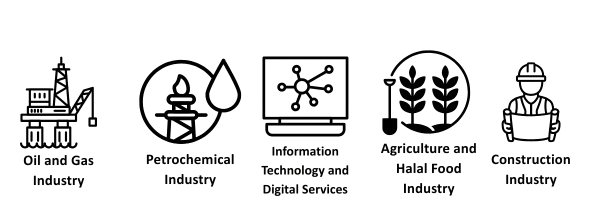
The oil and gas industry remains the core sector of Brunei’s economy, contributing a significant share of the county’s GDP and export revenue. In recent years, Brunei has expanded its downstream activities, particularly in petrochemicals and refining, to strengthen the value chain and diversify economic activities within the energy sector.
2.Digital Economy & ICT Sector
Brunei is actively developing its digital economy through initiatives such as the Digital Economy Masterplan, which aims to accelerate technological advancement and support economic diversification. The country has experienced growth in areas such as artificial intelligence (AI), fintech, and digital services, supported by continuous investment in digital infrastructure and smart nation initiatives
3.Tourism and Hospitality
Brunei’s tourism industry is growing steadily, with strong potential in eco-tourism and Islamic tourism due to the country’s rich natural environment and cultural identity. Key attractions such as tropical rainforests, Kampong Ayer, and Brunei’s cultural heritage continue to attract both regional and international visitor
4.Logistics, Services & Regional Trade Hub
Brunei’s strategic location within ASEAN and its participation in multiple trade agreements provide businesses with easier access to regional and international markets. Through various free trade agreements (FTAs), companies operating in Brunei can potentially reach a wider consumer base and strengthen their regional trade activities.
5.Halal, Food Production & Agriculture
Brunei is actively promoting itself as a halal food hub for ASEAN markets, creating opportunities for businesses involved in halal-certified products and services. Due to the country’s strong dependence on imported food products, there is consistent demand for quality food supplies and related industries.
1. Export-Based Entry
Brunei serve as an appropriate market for companies to enter and find out market demand by exporting their products or services, thereby not committing too much in investment. This is particularly advantageous for SMEs as it helps them manage the financial risk and test for the response of customers, market potential and business opportunities before further expansion.
2. Set up Local Presence (Subsidiary/Branch)
Foreign companies have 100% ownership and register as a private limited company in Brunei, giving businesses greater control over their operations and decision making processes. This will allow companies to establish themselves in the market and to benefit from Brunei’s business-friendly climate.
3. Collaborate with local companies or joint ventures
Foreign businesses can derive benefits from establishing partnerships with local businesses, as this will enable them to have greater knowledge about the market and access to business opportunities in Brunei. Local partners may be able to help with smoother market entry and business growth as they will know the customer preference, business practices and networks.
4. Assign local distributor or agent.
One of the most common market entry strategies that foreign SMEs take when entering Brunei is to appoint local distributors or agents to serve as their local presence on the market, which can help them to enter the market with lower barriers to entry and complexity. By using local representatives, companies can concentrate on product supply and business development, while not having to start full operations right away.
5. Relationship Building & Government Engagement
The establishment of personal relationship is a vital aspect in achieving business success in Brunei because trust and long term relationship is very crucial in doing business. Companies are encouraged to make regular visits and to have a local presence to build relationships with clients, partners and stakeholders.



Brunei’s largest upstream oil and gas operator. Operates onshore and offshore oil and gas fields, exploration, drilling, production, field development, and asset management and it’s joint venture between the Government of Brunei and Shell

Independent upstream operator involved in the development and production of offshore oil and gas assets in Brunei which focuses on mature field redevelopment and production optimization

Conducts offshore exploration, appraisal, field development, and production activities in Brunei through joint ventures and production sharing agreements

Exploration and production operator for deepwater and offshore acreage in Brunei. Focuses on exploration, field appraisal, development, and production

Upstream exploration, development, production, and operation of offshore oil and gas blocks in Brunei and one of the subsidiaries of PETRONAS

Joint venture between Serikandi Group and Kent PLC. Provides engineering, procurement, construction management (EPCM), brownfield modifications, asset integrity management, commissioning, operations and maintenance, and project management services

Provides operations and maintenance (O&M), plant maintenance, hook-up and commissioning, mechanical and electrical services, manpower supply, offshore support, and integrated oilfield services for upstream and downstream facilities

Supplies industrial, mechanical, electrical, instrumentation, safety, and oil & gas equipment to upstream and downstream industries

Provides engineering, procurement, construction, fabrication, maintenance, plant turnaround, mechanical, piping, and offshore support services for the oil and gas industry

Offers engineering, procurement, construction (EPC), fabrication, mechanical and electrical works, maintenance, and industrial support services for oil & gas and energy projects
Specializes in offshore and onshore fabrication, structural steel works, modular construction, maintenance, repair, and engineering solutions for the oil and gas sector

Provides offshore manpower supply, marine logistics, accommodation services, engineering support, vessel management, and project support for the oil and gas industry

Provides offshore construction, fabrication, engineering, procurement, installation, maintenance, hook-up and commissioning, and marine support services for the oil and gas industry

Provides offshore inspection, non-destructive testing (NDT), dimensional control, hydrographic and geophysical surveys, subsea inspection, and asset integrity services.

Provides marine logistics, offshore support, engineering services, equipment supply, and project management for offshore oil and gas operations

Offers integrated energy services including engineering, procurement, construction, maintenance, industrial services, and project management for oil & gas and renewable energy sectors.
MALAYSIAN GOVERNMENT OFFICES IN BRUNEI
High Commission of Malaysia
No. 61, Simpang 336
Jalan Kebangsaan
Bandar Seri Begawan
Email: mwbrunei@kln.gov.my
Tel: +673-2381096 /97
Web: www.kln.gov.my/web/brn_begawan
TRADE ASSOCIATIONS/ INSTITUTES BASED IN BRUNEI
Malaysia External Trade Development Corporation (MATRADE)
Lot C5.2A, Tingkat 5,
Blok C, Bangunan KWSP,
Jalan Karamunsing,
88100 Kota Kinabalu
Sabah
Email: sabah@matrade.gov.my
Tel: +06-088-240 881
Web: www.matrade.gov.my

 EN
EN  MY
MY